Norman Holmes
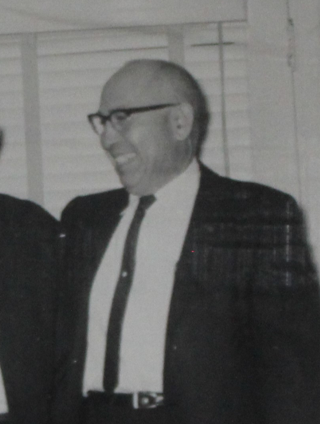
Norman Holmes
(1910-1985)
Norman Holmes was born in Ottawa County, Oklahoma in 1910 and was the cousin of Chief Clarence King. After graduating from Haskell Institute, Holmes began a long career at the Bureau of Indian Affairs. His experience in Indian Affairs gave him a complex view of federal policy—he valued some of the BIA’s services but opposed its paternalism.
Holmes became one of the most outspoken critics Ottawa termination in the 1950s. After joining the Anadarko Agency as an enrollment officer in 1956, he discovered that Ottawa termination legislation had passed without most tribal members being consulted. Outraged, Holmes challenged both the legality of the BIA-prepared termination roll and the authority of the Business Committee to endorse termination.
With his cousin Clarence King, Holmes organized a large 1958 tribal meeting. Risking his federal career, Holmes openly confronted agency officials about the termination process. Under pressure from Commissioner of Indian Affairs Glenn Emmons, Holmes was forced to cease his activism or resign his position with the BIA. He chose to remain in the BIA, but his resistance became a defining moment in Ottawa political history.
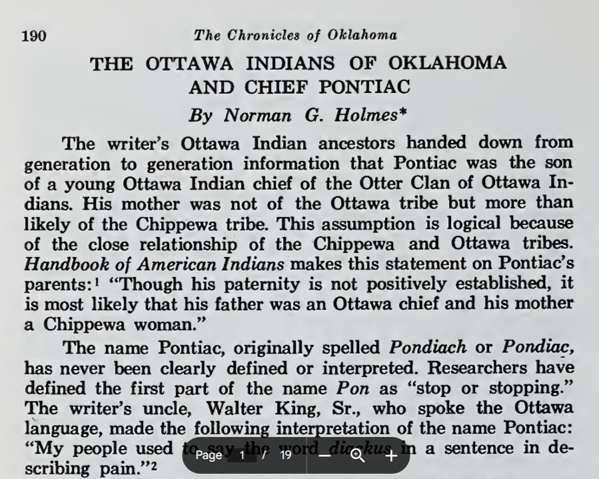
In addition to his government work, Holmes was an accomplished historian. He published the article “The Ottawa Indians of Oklahoma and Chief Pontiac” in the Chronicles of Oklahoma in 1967 and later contributed his research for the book The Ottawa Indian Tribe of Oklahoma: Past, Present, Future (1981).
-
![]()
Norman G. Holmes, “The Ottawa Indians of Oklahoma and Chief Pontiac,” Chronicles of Oklahoma 45 (1967): 190-206.
For full text, please follow the link.