Treaty of Greenville

Treaty of Greenville
(1795)
In July 1795, Ottawa tribal leaders negotiated the Treaty of Greenville that formally ended the Northwest Indian War.
Facing the invasion of their lands by settlers and military forces of the newly formed United States, Natives of the Great Lakes region united to resist American encroachment. The coalition resoundingly defeated the campaign of Josiah Harmar in 1790 and army of Arthur St. Clair in 1791. At the Battle of Fallen Timbers in 1794, however, the Native alliance faced defeat, and the Ottawas and other tribes ceded claims to southern Ohio in the Treaty of Greenville.
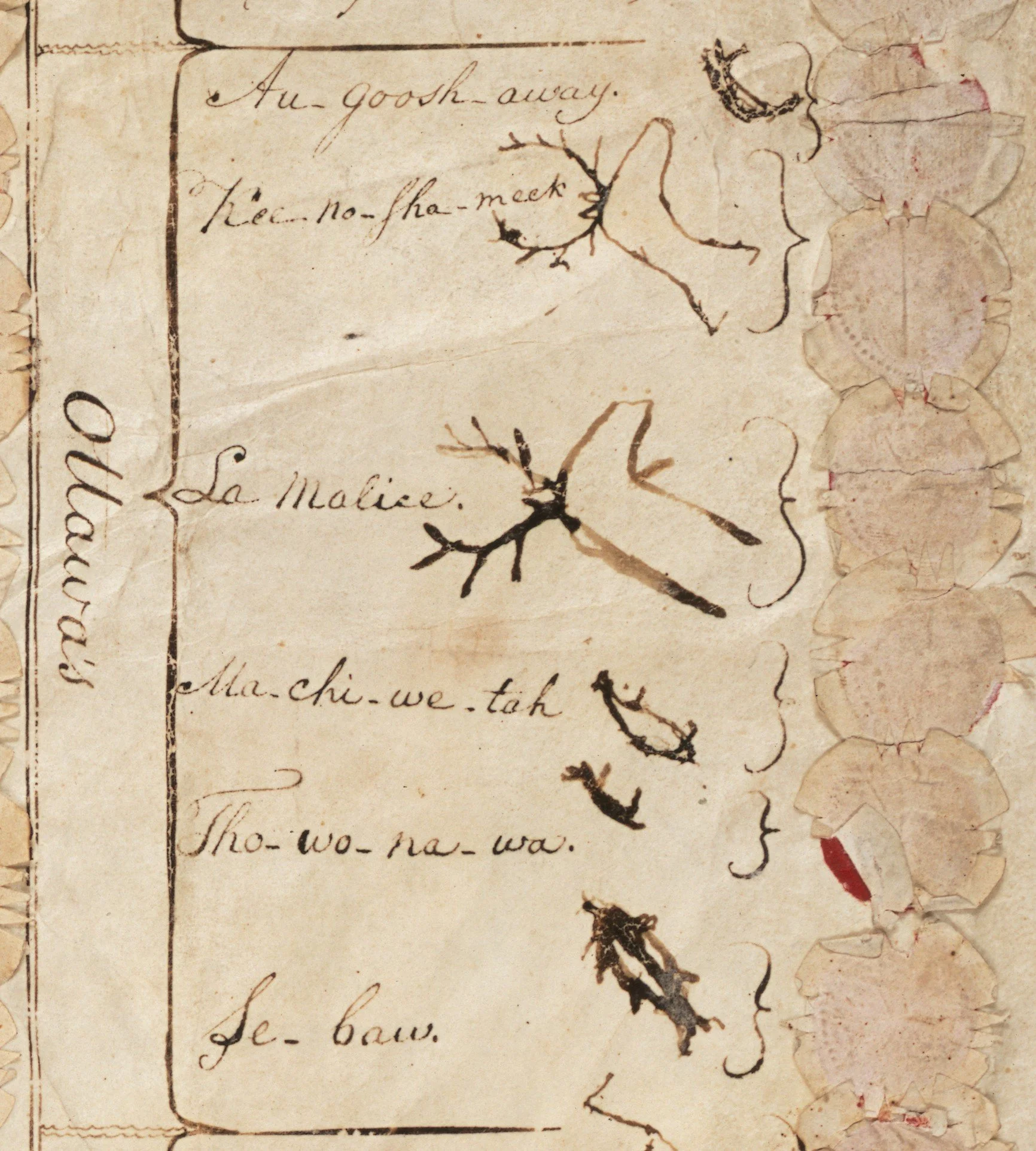
The head Ottawa signatory was Au-goosh-away (or Egushawa)—a powerful war leader regarded as the successor to Pontiac. Although in his sixties, Au-goosh-away actively participated in the Battle of Fallen Timbers and suffered severe injuries.
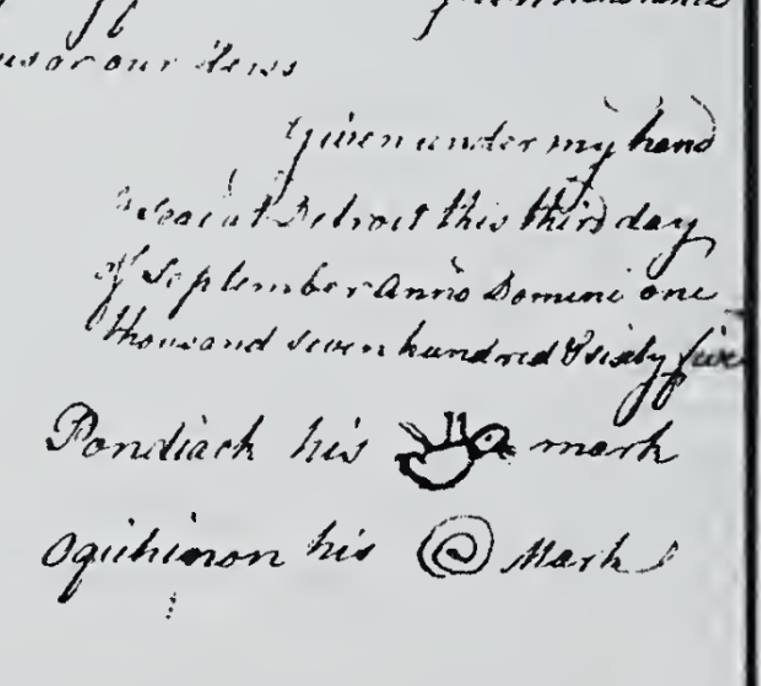
Tribal leaders often signed treaties with a symbol of their doodem or clan, and the Ottawa bands who resided near the Maumee River were generally of the Otter clan. Pontiac signed documents with an image of an Otter on its back, and it appears that Au-goosh-away did the same.
Robert F. Bauman, a historian who contributed his research toward Ottawa claims before the Indian Claims Commission in the 1950s, wrote an article about Au-goosh-away available here.
-
![]()
A close-up of the Ottawa signature symbols from the Treaty of Greenville.
-
![]()
Pontiac’s symbol used to sign a 1766 agreement.