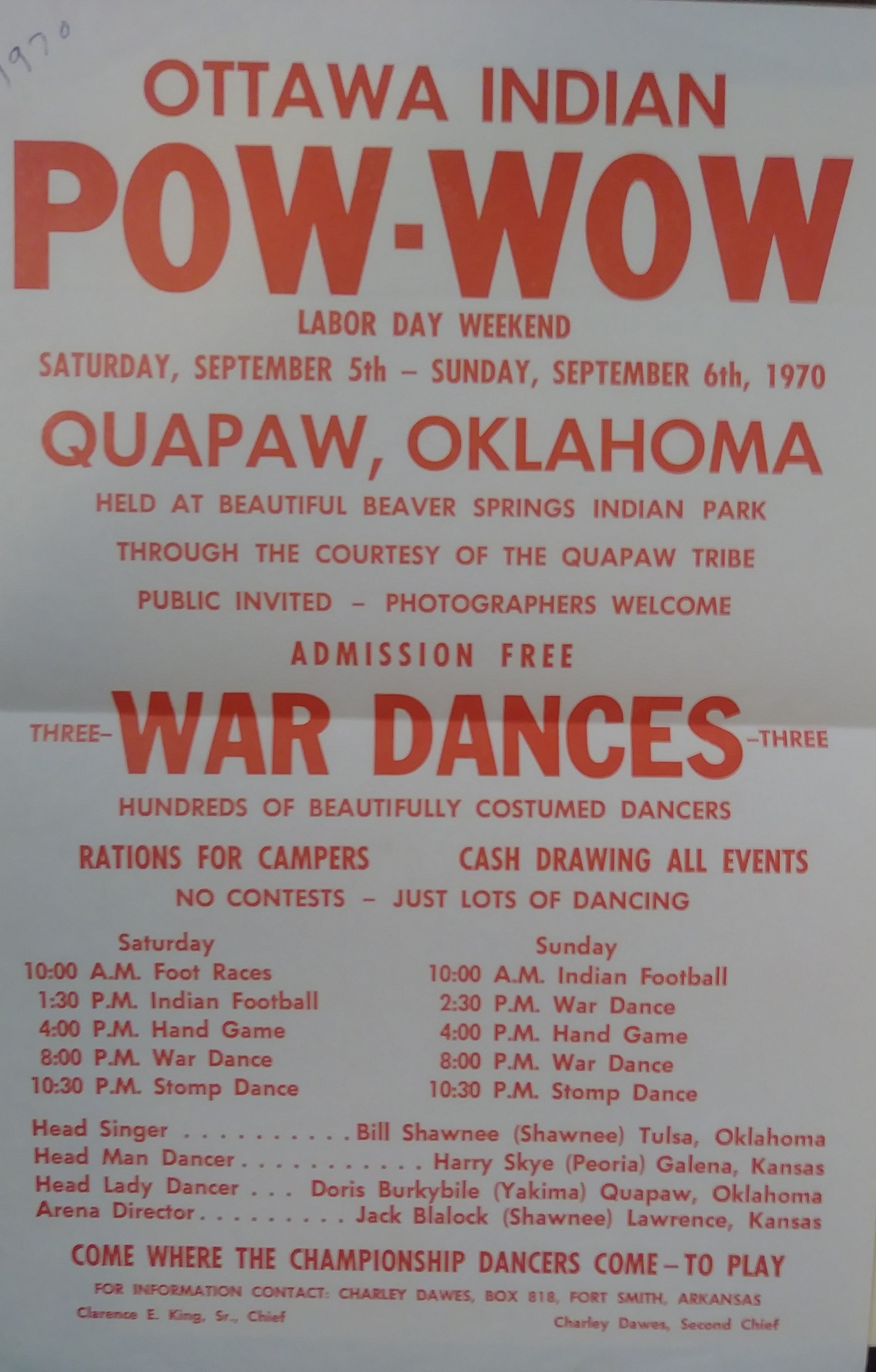
Ottawa Labor Day Powwow Established
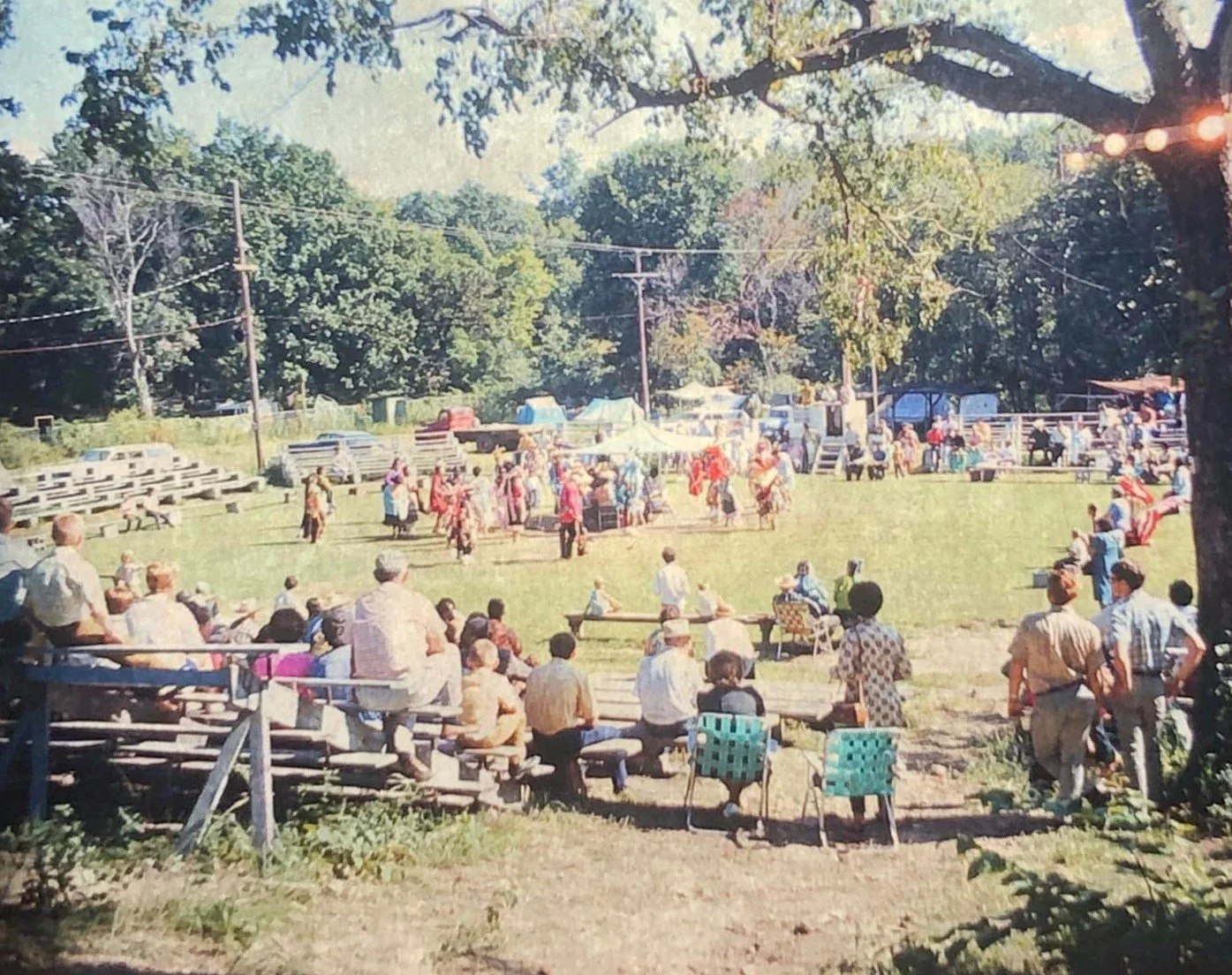
Ottawa Labor Day Powwow, 1968
Ottawa Labor Day Powwow Established
(1964)
The Ottawa Labor Day Powwow founded in 1964 emerged out of older Ottawa traditions. Dancing had always been an Ottawa pastime, and for generations, Ottawas held social dances with other tribes. As early as 1839, the Ottawas left their reservation in Kansas and went south to dance with the Quapaws, with whom they would later become neighbors and host regular events.
After removal from Kansas to Indian Territory, Ottawas hosted or participated in Fourth of July celebrations with other area tribes, and the Fourth of July became a significant annual milestone for tribal members. In the decades before and after allotment, the Ottawas hosted the Fourth of July powwow at Kings Spring or Pooler’s Grove. By the early 20th century, Ottawas increasingly gravitated toward the Quapaw Tribe’s Fourth of July festivities at Devil’s Promenade, held near Quapaw, Oklahoma. Ottawas adopted the Quapaw Fourth of July powwow as a summer gathering that brought Ottawa tribal members together from across the United States.
By the 1950s, the Quapaw powwow attracted large numbers of spectators, and hoping to recapture the intimacy of earlier gatherings, Ottawa leaders Charles Dawes and Clarence King established their own annual event. Dawes spearheaded the effort, and with the guidance of Clarence King, Leo Wistar, and Lottie Dawes (Na-watch), the first Ottawa Labor Day Powwow was held in 1964.
The event was scheduled over Labor Day weekend to allow far-flung tribal members to attend, and the event also served as a back-to-school dance for Ottawa youth. Without a tribal land base on which to host it, organizers secured permission to use Beaver Springs Indian Park in Quapaw, Oklahoma. The early powwows operated on limited funds and relied heavily on volunteer labor and community donations. Borrowed equipment and raffles of donated items sustained the event in its early years.
Unlike many powwows that emphasized competition and prize money, the Ottawa Labor Day Powwow offered free admission and parking and focused on fellowship and the celebration of tribal identity. The tagline “where the championship dancers come to play” reflected this spirit, and the Ottawa Powwow Princess title often honored an older woman rather than being tied to ticket sales or beauty contests. These traditions continue to this day.
For many Ottawas who came of age in the 1960s and 1970s, the powwow became central to their understanding of what it meant to be Ottawa. The event quickly grew from humble beginnings into the largest annual gathering of Ottawas. In 1986, tribal leaders dedicated new powwow grounds located on Ottawa tribal lands.