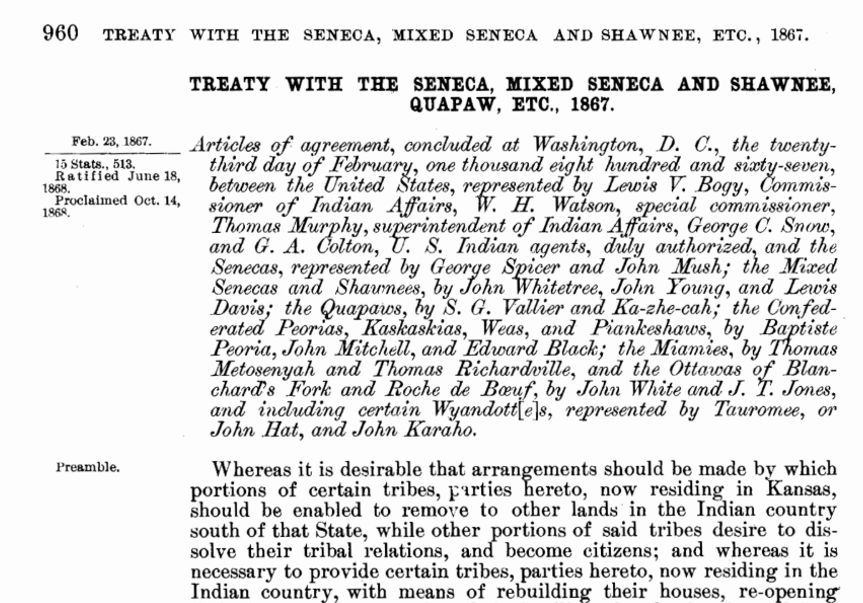
Treaty of Seneca, Mixed Seneca, Shawnee….Ottawa
Treaty of Seneca, Mixed Seneca, Shawnee….Ottawa
(1867)
The Ottawa Treaty of 1867 formalized Ottawa relocation from Kansas to Indian Territory (present-day northeastern Oklahoma). The treaty ratified an agreement between the Ottawa and the Shawnee in which the Ottawas purchased approximately 15,000 acres from the Shawnee Tribe at a cost of one dollar per acre. Federal officials characterized the agreement as government approval of arrangements already negotiated between the tribes.
The treaty emerged from conditions created by the United States’ failure to fulfill obligations under the 1862 Ottawa Treaty, including financial mismanagement and land fraud, which undermined the Ottawas’ ability to remain in Kansas. In response, Ottawa leader John Wilson explored relocation as a means of securing a stable homeland. Negotiations with the Shawnees drew upon longstanding intertribal relationships that dated to their shared residence in Ohio and were reinforced through mutual assistance during the Civil War.
In 1865, an Ottawa scouting delegation—consisting of William Hurr (Naw-swa-ke-shick), John W. Earley (Wash-kos), and James Wolfe—traveled to Indian Territory to evaluate the proposed lands. Following this assessment, the Ottawas proceeded with the purchase, and the first groups relocated south beginning in 1867.
-
![]()
“Treaty with the Seneca, Mixed Seneca and Shawnee, etc., February 23, 1867,” in Indian Affairs: Laws and Treaties, Vol. 2, edited by Charles J. Kappler (Washington, D.C.: Government Printing Office, 1903), 960-969.
For full text, please follow the link.