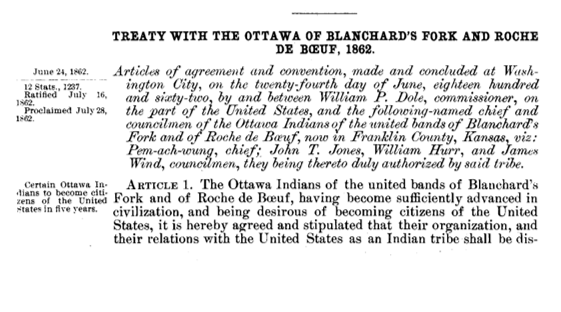
Treaty with the Ottawa of Blanchard's Fork and Roche de Boeuf
A warranty deed marking a land sale in Kansas
Treaty with the Ottawa of Blanchard's Fork and Roche de Boeuf
(1862)
The Ottawas always held treaties in high regard. In the 1850s, most tribal members could not read, so tribal leaders insisted that their missionary read old Ottawa treaties aloud on cold winter evenings. In June 1862, as the Civil War raged, the Ottawas signed a treaty with the United States government in Washington D.C. This treaty paved the way for Ottawa University, U.S. citizenship for the Ottawas, and the Ottawas’ first experiences with allotment and termination.
As Kansas filled up with settlers, the Ottawas faced mounting pressure for their lands. As successful farmers and businessmen, the Ottawas thought they could navigate American society if provided equality with their white counterparts, and rather than face removal, the Ottawas agreed to the termination of their formal political relationship with the United States and the allotment of their communal lands in return for “all the rights, privileges, and immunities” of U.S. citizenship.
According to the treaty, the Ottawa tribal “organization, and their relations with the United States as an Indian tribe shall be dissolved and terminated at the expiration of five years from the ratification…and every one of them, shall be deemed and declared to be citizens of the United States.” The treaty also provided for the allotment of the Ottawa reservation in Kansas, with most members receiving 80 or 160 acres.
To aid in the transition to U.S. citizenship, the treaty also set aside “twenty thousand acres…for the purpose of endowing a school for the benefit of said Ottawas.” The treaty stipulated, “the children of the Ottawas and their descendants, no matter where they may emigrate, shall have the right to enter said school and enjoy all the privileges thereof.”
The Ottawas held up their end of the bargain. Shortly after the treaty, Ottawas enlisted in the Union Army and even started voting in political elections; however, the Ottawa Indian Agent embezzled tribal funds, Kansas law and incoming settlers did not treat the Ottawas as equal citizens, and the land and monies set aside to establish an educational institution fell into corrupt hands. For over a century after its founding, Ottawa tribal members saw little benefit from the educational institution their lands had established through this treaty.
Although tribal members optimistically imagined a new political relationship as full U.S. citizens, Ottawa disappointment with the results of the 1862 treaty led the Tribe to buy a new reservation and endure removal from Kansas to Indian Territory following a new treaty in 1867.
-
![]()
“Treaty between the United States of America and the Ottawa Indians of Blanchard's Fork and Roche De Boeuf, June 24, 1862,”in Indian Affairs: Laws and Treaties, Vol. 2, edited by Charles J. Kappler (Washington, D.C.: Government Printing Office, 1903), 830-834.
For full text, please follow the link.