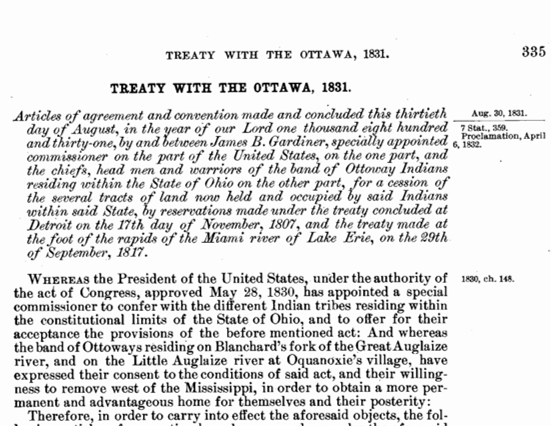
Treaty with the Ottawa
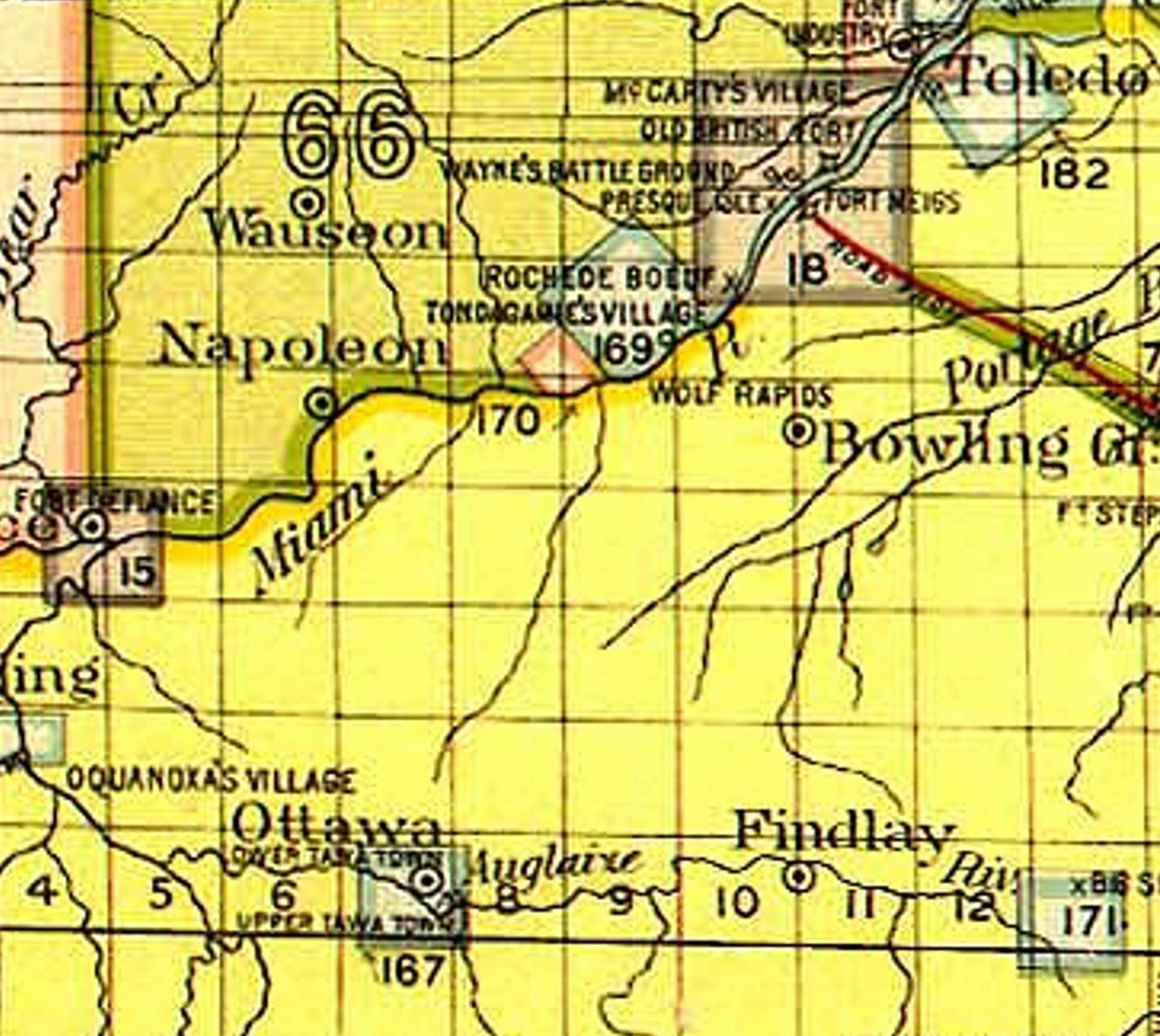
Treaty with the Ottawa
(1831)
By the 1820s, the land base of the Ottawa bands who lived along the Maumee River in Ohio had been dramatically reduced, and many Ottawa relied on debts incurred with traders to survive. Incoming settlers and local traders demanded Ottawa land cessions. Despite these pressures, many Ottawa communities resisted removal. The villages of Roche de Boeuf, Blanchard’s Fork, and Oquanoxie’s Village divided over whether to relocate west. Though they negotiated with the federal government as separate groups, all ultimately faced expulsion from their Ohio homelands.
The Treaty of 1831, signed by President Andrew Jackson, formalized Ottawa removal from Ohio. It stipulated that the Ottawas of Blanchard’s Fork and Oquanoxie’s Village would remove to a 34,000-acre reservation along the Marais des Cygnes River, in what later became Franklin County, Kansas. The treaty granted the land “in fee simple,” meaning full ownership. The Ottawas of Roche de Boeuf were to remove later and receive an adjoining 40,000-acre tract with the same protections.
The federal government forced the Ottawa to comply with removal orders. One Ottawa chief who had refused to sign the treaty was coerced into signing the treaty when intoxicated, and when the time for removal arrived, he was tied hand and foot, thrown into a wagon, and sent west.
In return for vacating their historic home, the federal government promised the Ottawa they would be secure and protected in their new homeland. The treaty declared that the new Ottawa reservation “shall never be within the bounds of any State or territory, nor subject to the laws thereof…and that the President of the United States will cause said band to be protected at their new residence, against all interruption or disturbance.” The treaty’s terms also mandated the federal government provide plows, harnesses, and other agricultural tools to aid the Ottawa transition to farming in Kansas.
The federal government failed to live up to these commitments. The promised plows were not there when the Ottawas arrived. As late as 1843, Ottawa leader Notino complained, the Ottawas “could get no other plowing done than what they did with their hoes.” This neglect deepened the hardships of removal. In an oral history about removal, Joseph Badger King recounts how around half of the Ottawas died shortly after removal.
Ultimately, in violation of the treaty, the Ottawa Reservation was encompassed within the Kansas Territory in 1854, white settlers flooded in and encroached on tribal lands and stole timber, and the Ottawa endured removal from Kansas in the late 1860s.
-
![]()
“Treaty with the Ottawa, 1831,” in Indian Affairs: Laws and Treaties, Vol. 2, edited by Charles J. Kappler (Washington, D.C.: Government Printing Office, 1903), 335-339.
For full text, please follow the link.